Jul 29, 2026Industry News
Common Causes of Fastener Failure in Machinery and How to Prevent Them
Learn the common causes of fastener failure in machinery, including corrosion, improper installation, material issues, and how to prevent bolt failures.
Fasteners are small components, but they play a critical role in the safety and reliability of mechanical equipment. Bolts, nuts, and screws are used to hold machine parts together, transfer loads, and maintain structural integrity during operation.
However, fastener failure is a common issue in machinery, automotive equipment, industrial systems, and heavy-duty applications. A failed bolt may lead to equipment downtime, production losses, safety risks, or even serious mechanical accidents.
Understanding the common causes of fastener failure helps engineers, manufacturers, and purchasing teams select the right fasteners and avoid unnecessary failures.
This article explains the major causes of bolt and fastener failure and provides practical solutions to improve connection reliability.
1. Incorrect Fastener Selection
One of the most common causes of fastener failure is choosing the wrong fastener for the application.
Fasteners must be selected according to:
- Load requirements
- Operating environment
- Material compatibility
- Strength grade
- Thread specifications
Using a fastener with insufficient strength can cause deformation, cracking, or sudden breakage under heavy loads.
For example, a standard Grade 8.8 bolt may be suitable for general mechanical applications, but equipment exposed to higher loads or repeated stress may require Grade 10.9 or Grade 12.9 high-strength bolts.
Other common selection mistakes include:
- Incorrect bolt diameter
- Insufficient thread engagement
- Wrong material choice
- Fastener not suitable for temperature or chemical conditions
How to Prevent It
Before purchasing fasteners, engineers should evaluate:
- Required tensile strength
- Shear load requirements
- Working environment
- Safety factors
Working with an experienced fastener supplier can help ensure the selected product meets application requirements.
2. Thread Problems and Poor Thread Engagement
Threads are the key connection point between bolts and nuts. Any problem with thread quality can significantly reduce fastening performance.
Common thread-related failures include:
Thread Damage
Damaged threads may occur during:
- Manufacturing
- Transportation
- Installation
A damaged thread cannot provide proper clamping force and may lead to loosening or failure.
Incorrect Thread Engagement
Insufficient thread engagement reduces the load-bearing area between the bolt and nut.
This may cause:
- Thread stripping
- Reduced holding strength
- Connection failure
Poor Machining Accuracy
Incorrect thread dimensions or poor machining quality can result in:
- Loose fitting
- Uneven load distribution
- Premature failure
How to Prevent It
Reliable fastener production should include:
- Thread inspection
- Dimensional inspection
- Proper machining control
- Batch quality checks
For critical applications, customers should request inspection reports or material documentation from suppliers.
3. Corrosion Damage
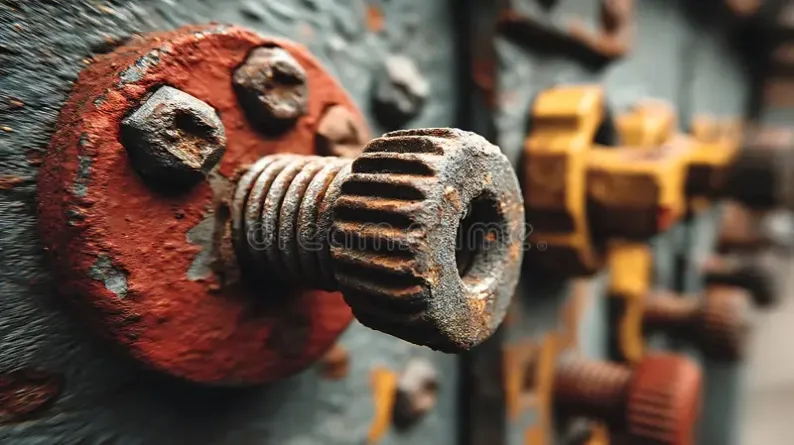
Corrosion is another major cause of fastener failure, especially in outdoor, marine, chemical, and industrial environments.
When fasteners are exposed to moisture, salt, or chemicals, corrosion can gradually reduce their strength.
Common corrosion causes include:
- Humidity and water exposure
- Salt spray environments
- Chemical contact
- Poor surface protection
Corrosion may lead to:
- Reduced bolt diameter
- Surface cracks
- Loss of mechanical strength
- Sudden fracture
Common Corrosion Protection Methods
Different environments require different surface treatments.
Zinc Plating
Suitable for general indoor applications and provides basic corrosion resistance.
Hot Dip Galvanizing
Commonly used for outdoor structures, construction projects, and applications requiring stronger corrosion protection.
Stainless Steel Fasteners
Stainless steel fasteners provide excellent corrosion resistance and are widely used in:
- Food equipment
- Marine applications
- Architectural projects
Zinc Nickel Coating
Zinc nickel coating provides enhanced corrosion resistance compared with traditional zinc plating and is often used in automotive and industrial applications.
Choosing the correct surface treatment is essential for extending fastener service life.
4. Improper Installation
Even high-quality fasteners can fail if they are installed incorrectly.
Incorrect installation is one of the most overlooked causes of bolt failure.
Common installation problems include:
Over Tightening
Applying excessive torque can stretch the bolt beyond its elastic limit.
Possible results:
- Bolt deformation
- Thread damage
- Reduced fatigue resistance
Under Tightening
Insufficient tightening force may cause:
- Bolt loosening
- Vibration problems
- Reduced joint stability
Incorrect Torque Control
Without proper torque control, different bolts in the same assembly may have inconsistent clamping forces.
This creates uneven stress distribution and increases failure risks.
How to Prevent It
Recommended practices include:
- Using proper torque tools
- Following manufacturer specifications
- Training installation personnel
- Performing torque inspections when necessary
5. Material Quality Issues
Fastener performance depends heavily on material quality and manufacturing control.
Low-quality materials may cause:
- Insufficient tensile strength
- Unexpected cracking
- Poor fatigue resistance
- Inconsistent mechanical properties
For industrial applications, buyers should pay attention to:
- Raw material certificates
- Heat treatment records
- Mechanical testing results
- Batch traceability
A reliable fastener supplier should maintain strict quality control from raw materials to finished products.
Typical quality control processes include:
- Incoming material inspection
- Production process monitoring
- Dimension inspection
- Final product inspection
For demanding applications, third-party inspections such as SGS or BV testing may also be considered.
6. Fatigue Failure Under Repeated Loads
Unlike static loads, repeated stress can gradually damage fasteners over time.
Fatigue failure is common in:
- Automotive applications
- Industrial machinery
- Construction equipment
- Heavy-duty machines
During operation, vibration and cyclic loading repeatedly stress the bolt.
Over time, small cracks may develop and expand until the bolt suddenly breaks.
Common signs of fatigue failure include:
- Cracks near thread areas
- Fracture surfaces
- Unexpected bolt breakage
How to Prevent Fatigue Failure
Solutions include:
- Selecting proper strength grades
- Improving surface treatment
- Maintaining correct preload
- Avoiding excessive vibration
- Conducting regular inspections
How to Choose Fasteners to Avoid Failure?
When selecting fasteners for machinery applications, consider the following factors:
1. Application Requirements
Understand:
- Load conditions
- Operating temperature
- Environmental exposure
- Expected service life
2. Material and Strength Grade
Choose suitable materials such as:
- Carbon steel
- Alloy steel
- Stainless steel
Select the correct strength grade according to mechanical requirements.
3. Surface Treatment
Consider corrosion protection requirements:
- Zinc plating
- Hot dip galvanizing
- Zinc nickel coating
- Other customized coatings
4. Supplier Quality Control
A qualified supplier should provide:
- Material certificates
- Inspection records
- Consistent production quality
- Reliable delivery capability
Frequently Asked Questions About Fastener Failure
What are the most common causes of bolt failure?
The most common causes include incorrect fastener selection, corrosion, improper installation, poor material quality, thread problems, and fatigue caused by repeated loading.
Why do bolts break under normal working conditions?
Bolts may break because of excessive stress, incorrect torque, material defects, corrosion damage, or fatigue cracks caused by continuous vibration.
How can bolt failure be prevented?
Bolt failure can be prevented by selecting the correct strength grade, using suitable surface treatments, controlling installation torque, and purchasing from reliable fastener manufacturers.
Does corrosion affect bolt strength?
Yes. Corrosion reduces the effective cross-section of bolts and may create cracks that significantly weaken the fastener.
Conclusion
Fastener failure in machinery is usually caused by a combination of factors, including incorrect selection, poor installation, corrosion, material problems, and fatigue.
Although fasteners are small components, their quality directly affects equipment safety, reliability, and operating costs.
By selecting the right fastener specifications, using appropriate surface treatments, applying correct installation methods, and working with a reliable supplier, companies can significantly reduce bolt failures and improve machinery performance.
For industrial buyers, fastener quality is not only about product price — it is about long-term reliability and preventing unexpected downtime.