Oct 11, 2026Industry News
Ferrule Fittings: Types, Standards and Installation Guide
Learn how ferrule fittings work, the difference between single and double ferrule designs, common materials (304/316 stainless steel, brass), relevant standards, plus selection and installation tips.
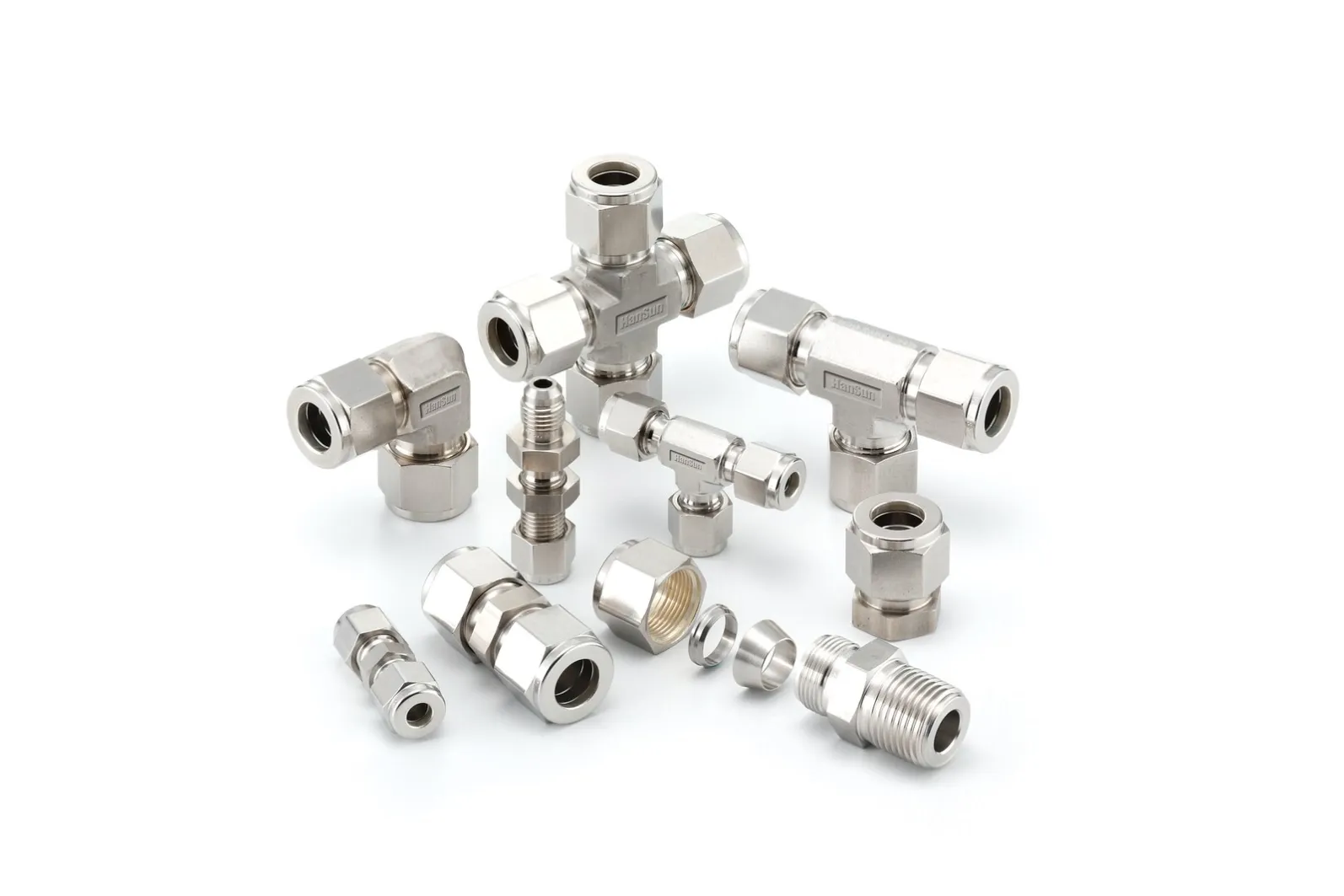
Ferrule fittings — also described as compression tube fittings and widely used as instrumentation tube fittings — are detachable mechanical connectors for metal tubing in instrument, hydraulic, and pneumatic lines. A nut drives a ferrule so that it bites into the tube wall and seats against a cone inside the body, which both holds the tube and seals the joint. Compared with welding, ferrule fittings assemble faster on site and are easier to inspect or replace; compared with plain threaded joints, they tend to seal more repeatably on small-bore metal tubing. Single ferrule and double ferrule designs cover different reliability and vibration demands, while materials such as 304 or 316 stainless steel, or brass, suit different media and environments.
What Is a Ferrule Fitting?
A ferrule fitting is a mechanical tube connector made up of a body, a nut, and one or more ferrules. It joins metal tube — stainless steel, copper, and some rigid plastics — without welding or brazing. During assembly, the axial thrust from the nut deforms the ferrule both elastically and plastically: one end bites into the outside wall of the tube, while the other presses tightly against the cone of the body.
The result is two functions in one connection: sealing and resistance to pull-out. Because the joint is detachable, ferrule fittings suit lines assembled on site, serviced often, or located where hot work is impractical. The same family is often grouped in supplier catalogs as a compression tube fitting or instrumentation tube fitting.
Structure and Working Principle
Key components
- Body — contains the precision internal cone that acts as the sealing datum, and carries the connecting thread.
- Nut — rotates to generate the axial thrust that compresses the ferrule.
- Ferrule — the deforming part that contacts both the tube and the body; it is the heart of the seal.
How the seal forms
Tightening is typically described in two stages. First, the leading edge of the ferrule is pressed into the tube's outer wall, creating mechanical grip and a first seal. Second, the outer cone of the ferrule and the inner cone of the body are pressed together, forming a second seal. When selection, tightening, and tube matching are all correct, this two-stage arrangement is generally understood to help the connection stay stable under vibration and pressure fluctuation. Sealing quality depends on several variables at once — tube outside-diameter tolerance, hardness, surface condition, and how far the fitting is tightened — so the connection is best judged as a system rather than by any single part.
Types: Single Ferrule vs Double Ferrule
Single ferrule
A single-ferrule fitting uses one ferrule. Fewer parts and a simpler structure make it a common choice for general service and cost-sensitive projects.
Double ferrule
A double-ferrule fitting uses a front ferrule and a back ferrule. The front ferrule handles biting and sealing; the back ferrule mainly carries the nut thrust and helps resist vibration. It is usually chosen where sealing reliability and vibration resistance matter more.
Which type fits a given line depends on the medium, pressure, and vibration conditions; confirm the choice with the supplier rather than assuming equivalence.
Common Materials
- 304 stainless steel — good general versatility and moderate corrosion resistance; common in general industrial tubing.
- 316 / 316L stainless steel — the addition of molybdenum is typically associated with higher corrosion resistance, which is why 316 stainless steel ferrule fittings are often considered for some chemical and marine environments.
- Brass — easy to machine and lower in cost; often used in low-pressure pneumatic, instrumentation, and small-bore copper systems.
- Others — carbon steel, alloy steel, and duplex grades are available for specific service conditions.
Suitable media, temperature range, and corrosion performance vary considerably between materials. Material selection should follow the supplier's material documentation and a medium-compatibility reference, not a generic rule.
Relevant Standards
Standards commonly cited in this field include GB/T 3733, usually associated with the Chinese standards system; DIN 2353, usually associated with the German and European system; and ISO 8434-1, usually associated with the international system. BS, JIS, and manufacturer-specific standards may also apply. These standards are commonly cited; verify the current version and scope before publishing. Cone angle, thread form, and size series are not interchangeable between standards, so mixing parts across standards carries risk. Standard numbers here are only a starting point for reference and search; they do not confirm that the current edition has been checked. For design and procurement, always work from the currently valid edition of the standard text.
Typical Applications
- Instrumentation and control loops (connections to pressure, level, and flow transmitters)
- Low-pressure lines in hydraulic systems
- Pneumatic system tubing
- Laboratory and analytical instruments, and gas delivery lines
- Other metal tubing that is serviced often or difficult to weld
Whether a fitting suits a specific duty still needs to be assessed against the medium, pressure, temperature, and vibration conditions of that line.
Selection Checklist
- Service conditions — medium, working pressure and temperature range, vibration, and thermal cycling.
- Tube matching — outside diameter, wall thickness, material, hardness, and surface condition.
- Material compatibility — corrosion and galvanic-corrosion risk between the fitting, the medium, and the tube.
- Standard and thread — metric, NPT, BSPP, and similar; avoid mixing thread systems.
- Ferrule type — single or double, traded off between reliability and cost.
- Supplier capability — dimensional consistency, batch-to-batch stability, inspection, and material certificates.
Installation and Tightening Pointers
- Cut the tube square and flat, with a perpendicular cut and no ovality.
- Deburr and clear all chips.
- Insert the tube fully to the shoulder in the fitting body.
- Hand-tighten first to confirm the nut is not cross-threaded or skewed.
- Tighten to the turns or torque given in the supplier's instructions — do not over-torque by feel.
- Avoid repeated over-tightening; after re-assembly, inspect the ferrule and replace it if it looks abnormal.
The actual number of turns or torque value always follows the specific product instructions.
FAQ
1. Ferrule fitting vs welded joint?Welding is stronger and suits high-pressure, high-temperature service, but it requires hot work and is hard to take apart. A ferrule fitting assembles quickly on site and can be detached, which suits small- and medium-bore lines that are serviced frequently.
2. Single ferrule vs double ferrule?For general service, a single ferrule can help control cost; where reliability and vibration resistance are the priority, a double ferrule is usually considered. Decide on the supplier's recommendation and your own testing.
3. Can a ferrule fitting be reused?The body and nut can normally be reused; the ferrule is generally treated as single-use. After repeated re-assembly, inspect the ferrule and replace it if anything looks abnormal.
4. How do I troubleshoot a leak?Check the tube cut for flatness and burrs, confirm the tube is fully inserted, and verify that tightening meets the specification — then check the match between the tube and the ferrule.
5. 304 vs 316 — which should I choose?304 suits general environments; 316 is typically more corrosion-resistant because of its molybdenum content. Base the choice on the medium and the environment.
6. Can fittings from different standards be interchanged?Size and thread systems are not fully identical, so directly mixing them carries risk. Keep to one standard or confirm compatibility with the supplier.
Request a Quote, Samples, or Technical Data
Need a quotation, samples, or a technical data sheet? Send us the medium, pressure and temperature range, tube size, material requirement, target standard, and purchase quantity so we can respond accurately. SENOTECH supplies stainless steel ferrule fittings and related hardware; contact us for tailored recommendations.