Jul 31, 2026Industry News
Hot Forged vs Cold Formed: Which Manufacturing Process Is Better?
Compare hot forged and cold formed bolts by size, strength, accuracy, cost, and application to choose the right process.
When sourcing bolts, nuts, and other industrial fasteners, buyers often focus on material grade, dimensions, surface treatment, and price. However, the manufacturing process can also influence dimensional consistency, production cost, surface condition, tooling requirements, and the range of sizes that can be produced efficiently.
Two of the most common fastener manufacturing methods are cold forming, also known as cold heading, and hot forging.
Cold forming is widely used for standard bolts, screws, and nuts produced in large quantities. Hot forging, on the other hand, is often selected for large-diameter, heavy-section, or customized fasteners that require greater material deformation.
So, are hot forged bolts better than cold formed bolts?
The answer depends on the fastener size, material, geometry, production quantity, tolerance requirements, and final application. Neither process is automatically superior in every situation.
What Is Cold Forming or Cold Heading?
Cold forming is a manufacturing process in which metal wire or bar is shaped at or near room temperature by applying high pressure through a series of punches and dies.
In a typical cold-heading process, coiled wire is cut to the required length and transferred through several forming stations. Each station gradually changes the shape of the material until the bolt head, nut body, or other required geometry is completed.
Cold heading is technically one type of cold forming, although the two terms are often used interchangeably in the fastener industry.
National Machinery describes cold forming as a high-speed forging process in which wire is cut and progressively shaped through multiple tooling stations. Multi-stage forming allows manufacturers to distribute deformation across several operations and produce complex fastener shapes efficiently.
Advantages of Cold Forming
Cold forming offers several important benefits:
- High production speed
- Excellent dimensional consistency
- Good surface finish
- Efficient material utilization
- Low unit cost for high-volume orders
- Reduced machining requirements
- Increased hardness and strength through work hardening
- Repeatable production of standard fastener dimensions
The Forging Industry Association identifies close dimensional tolerances, good surface finish, and work hardening as major advantages of cold forging.
Because the material is formed rather than extensively machined, cold forming can also maintain favorable grain flow around the head and body of the fastener. This can contribute to reliable mechanical performance when the tooling, raw material, heat treatment, and forming sequence are properly controlled.
Limitations of Cold Forming
Cold forming also has practical limitations.
Since the material is shaped at room temperature, significantly higher forming forces may be required. As the diameter, head size, wall thickness, or deformation ratio increases, the load on the machine and tooling rises considerably.
Possible limitations include:
- High press-force requirements
- Expensive multi-station tooling
- Increased die wear
- Risk of cracking if the material exceeds its forming limit
- Restrictions on very large diameters or heavy cross-sections
- Limited suitability for certain high-strength or low-ductility materials
- Higher initial tooling investment for customized products
Research comparing hot and cold forging generally finds that cold forging provides better dimensional accuracy but requires higher forming forces.
For this reason, cold forming is especially attractive when the product has a stable design and will be manufactured repeatedly in large quantities.
What Is Hot Forging?
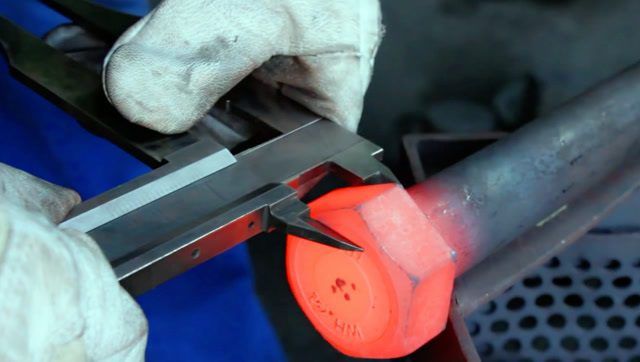
Hot forging shapes the fastener after the steel has been heated above its recrystallization temperature.
At this temperature, the material becomes easier to deform and can undergo substantial changes in cross-section without accumulating the same level of strain hardening associated with room-temperature forming.
The Forging Industry Association defines hot forging as plastic deformation performed above the material’s recrystallization point, allowing deformation to take place without continued strain hardening.
For bolts and nuts, a heated billet or cut bar is placed into forging dies and pressed or struck into the required shape. Depending on the product, later operations may include:
- Flash trimming
- Shot blasting or scale removal
- Machining
- Drilling and tapping
- Thread rolling or thread cutting
- Heat treatment
- Surface coating
- Final dimensional inspection
Hot-forming systems are commonly used for steel components such as large nuts, bearing rings, flanges, and other heavy-section parts manufactured from bar stock.
Advantages of Hot Forging
Hot forging is often selected because it offers:
- Better formability for large cross-sections
- Lower deformation resistance during forming
- Greater flexibility for large or unusual geometries
- Reduced risk of cold-forming cracks
- Suitability for heavy-duty bolts and nuts
- Better feasibility for medium-volume custom production
- Capability to process materials that are difficult to cold form
- Favorable grain flow compared with fully machined components
Forging can orient the grain structure along the shape of the component, which may improve reliability, impact resistance, and fatigue performance compared with manufacturing methods that cut through the original grain flow.
Limitations of Hot Forging
Hot forging may require more secondary processing than cold forming.
Typical considerations include:
- Heating energy and temperature control
- Oxide scale on the forged surface
- Possible surface decarburization if heating is not properly controlled
- Wider as-forged dimensional tolerances
- Additional machining or sizing operations
- Lower production speed than high-volume cold heading
- Greater variation if billet temperature and die filling are poorly controlled
Surface scale and slight decarburization may occur during steel heating, which is why heating conditions and later surface treatment must be carefully managed.
Hot-forged fasteners can still achieve accurate final dimensions, but machining, calibration, trimming, or other finishing operations may be necessary.
Hot Forging vs Cold Forming Comparison
Comparison Factor | Cold Forming | Hot Forging |
|---|---|---|
Forming temperature | At or near room temperature | Above the material’s recrystallization temperature |
Typical raw material | Coiled wire or prepared bar | Cut bar or billet |
Best suited for | Standard and repeatable fasteners | Large, heavy, or customized fasteners |
Production volume | Medium to very high volume | Low, medium, or specialized production |
Production speed | Generally higher | Generally lower |
Forming force | Higher because the material is cold | Lower because heated steel deforms more easily |
Dimensional accuracy | Excellent as formed | May require machining or sizing |
Surface finish | Smooth, with little or no scale | Oxide scale may need to be removed |
Material utilization | Very efficient | Efficient, but flash and machining allowance may be required |
Tooling investment | High for complex multi-stage tooling | Depends on part geometry and production method |
Design flexibility | Best for stable, repeatable designs | More flexible for large or unusual geometries |
Mechanical effect | Work hardening occurs during forming | Recrystallization occurs during deformation |
Typical products | Standard bolts, screws, rivets, and nuts | Large bolts, heavy nuts, flanges, rings, and custom forgings |
Are Hot Forged Bolts Stronger Than Cold Formed Bolts?
Hot forged bolts are not automatically stronger than cold formed bolts.
The final mechanical performance of a fastener depends on several factors:
- Steel grade
- Chemical composition
- Grain flow
- Heat-treatment process
- Property class
- Thread manufacturing method
- Surface condition
- Decarburization control
- Internal defects
- Dimensional accuracy
- Quality inspection
Cold forming can increase material strength through work hardening. Hot forging can accommodate greater deformation while producing favorable grain flow and preparing the component for controlled heat treatment.
A properly manufactured cold formed bolt may outperform a poorly controlled hot forged bolt, just as a properly designed and heat-treated hot forged bolt may be more suitable for a large or heavily loaded connection.
Buyers should therefore compare the required mechanical standard and test results rather than evaluating quality based only on whether the product is hot forged or cold formed.
Relevant requirements may include:
- Tensile strength
- Yield strength
- Proof load
- Hardness
- Impact performance
- Fatigue resistance
- Wedge tensile testing
- Decarburization testing
- Magnetic particle inspection
- Material traceability
Why Are Large Nuts, Such as L22 and Above, Often Hot Forged?
In a recent project involving L22-series and larger nuts, the buyer asked whether the complete range could still be manufactured through cold forming.
For the larger sizes, the selected production method was hot forging.
The main reason was not that cold forming is an inferior process. The issue was whether the required amount of material could be displaced consistently without creating excessive forming loads, tooling stress, or cracking risks.
1. Larger Cross-Sections Require More Forming Force
As the outside diameter, height, or wall thickness of a nut increases, significantly more metal must be moved into the die cavity.
Cold forming this volume of steel requires powerful equipment, durable tooling, multiple forming stages, and carefully prepared material. In some production environments, hot forging provides a more stable and economical solution.
2. Heated Steel Has Better Formability
Heating reduces the material’s resistance to deformation.
This allows the manufacturer to create larger hexagonal bodies, thicker walls, and heavier sections without applying the extreme pressures that would be required at room temperature.
3. Hot Forging Can Reduce Cold-Cracking Risk
If the deformation ratio exceeds the material’s cold-forming capability, cracks may develop during heading, upsetting, or extrusion.
The risk depends on:
- Material ductility
- Steel cleanliness
- Annealing condition
- Lubrication
- Tool design
- Deformation ratio
- Number of forming stages
- Machine capacity
Hot forging provides greater forming flexibility when these factors make cold forming difficult.
4. Large Fasteners Often Require Additional Machining Anyway
Large or specialized nuts may require drilling, tapping, turning, chamfering, or customer-specific marking after the main body is formed.
When secondary machining is already part of the production route, the dimensional advantages of cold forming may become less important than process stability and tooling feasibility.
5. Order Quantities May Not Justify Large Cold-Heading Tooling
Cold forming is highly economical when the same product will be manufactured in large quantities.
For a large customized nut with moderate demand, the initial investment in specialized cold-forming dies and machine setup may be difficult to recover. Hot forging may therefore offer a more practical balance between tooling cost, quantity, and production flexibility.
Is L22 a Universal Boundary Between Cold Forming and Hot Forging?
No.
There is no universal industry rule stating that every L22, M22, or larger fastener must be hot forged.
The practical production boundary depends on:
- Fastener geometry
- Material grade
- Machine tonnage
- Number of forming stations
- Tooling design
- Required deformation
- Manufacturer experience
- Annual order volume
- Required tolerance
- Available secondary operations
The Forging Industry Association notes that cold-forging process design depends on material formability, die loading, press loading, equipment characteristics, and the selected forming sequence. Therefore, the L22 threshold should be treated as a factory- and product-specific manufacturing decision rather than a universal standard.
Some advanced cold-forming factories can produce relatively large fasteners, while another manufacturer may select hot forging for the same nominal size.
How to Choose the Right Fastener Manufacturing Process
The correct process should be selected according to the complete product requirement—not diameter alone.
Choose Cold Forming When:
- The fastener has a standard or stable design.
- The order quantity is sufficiently high.
- Tight dimensional consistency is required.
- A smooth as-formed surface is important.
- The material has suitable cold-forming ductility.
- High production efficiency is a priority.
- The available equipment can handle the required forming load.
- Minimal machining is preferred.
Choose Hot Forging When:
- The fastener has a large diameter or heavy cross-section.
- Significant material displacement is required.
- The geometry is difficult to produce at room temperature.
- The material has limited cold-forming capability.
- The order quantity does not justify complex cold-heading tooling.
- Machining and heat treatment are already required.
- The product is customized for heavy-duty equipment.
- Production flexibility is more important than maximum output speed.
Hot forging is often considered for Heavy Hex Nuts, large bolts, structural components, hydraulic connection parts, and other Custom Fasteners.
Information Buyers Should Provide Before Production
To determine whether hot forging or cold forming is more suitable, the supplier should review more than a simple product name.
A complete inquiry should include:
- Product drawing or applicable standard
- Thread size and thread pitch
- Overall dimensions and tolerances
- Material grade
- Required property class
- Heat-treatment requirement
- Surface finish or coating
- Required quantity and annual demand
- Marking or logo requirement
- Inspection and testing requirements
- Application and working environment
- Required certificates or third-party inspection
For customized components, an experienced OEM Fastener Manufacturing supplier should evaluate the drawing, forming ratio, tooling feasibility, machining allowance, heat-treatment route, and testing plan before confirming the process.
Frequently Asked Questions
Is Cold Heading the Same as Cold Forming?
Cold heading is a type of cold forming mainly used to enlarge or shape sections of wire or bar, such as forming the head of a bolt. In everyday fastener manufacturing, the terms are often used interchangeably.
Can Large Bolts Be Cold Formed?
Yes, some large bolts can be cold formed if the manufacturer has suitable equipment, tooling, material preparation, and process experience. However, the required forming force and tooling cost increase as the bolt becomes larger or more complex.
Do Hot Forged Bolts Always Require Machining?
Not always. The amount of machining depends on the forging accuracy, product geometry, tolerance, and thread requirements. Large customized bolts frequently require secondary machining, while precision hot-forging processes may reduce the amount of machining needed.
Can Cold Formed Fasteners Be Heat Treated?
Yes. Cold formed bolts and nuts are often heat treated to achieve specified property classes. Cold forming and heat treatment are separate parts of the production route.
Which Process Is More Cost-Effective?
Cold forming is generally more cost-effective for large production quantities of repeatable parts. Hot forging may be more economical for large sizes, heavy sections, specialized materials, or customized orders where cold-forming tooling would be too complex or expensive.
Conclusion
The choice between hot forged bolts and cold formed bolts should not be reduced to a simple question of which process is stronger or better.
Cold forming offers excellent accuracy, surface finish, material efficiency, and production speed, making it ideal for high-volume standard fasteners.
Hot forging provides greater formability and flexibility for large-diameter, heavy-section, and customized fasteners, particularly when the required geometry would create excessive cold-forming loads or tooling risks.
For large nuts such as certain L22-series and larger products, hot forging may be the preferred manufacturing route. However, this size should not be treated as a universal industry cutoff. The final decision must be based on the material, dimensions, equipment, order quantity, tolerance, heat treatment, and application requirements.
SENOTECH supplies standard and customized bolts, nuts, and industrial fastening components for machinery, construction, hydraulic systems, and other demanding applications. Send us your drawing, material requirement, quantity, and required standard, and our team will help evaluate the appropriate manufacturing process for your project.