Aug 7, 2026Industry News
Wire Rope Clips: How to Select, Install and Inspect Them Correctly
Learn how to select, install and inspect wire rope clips correctly, including clip types, direction, quantity and common installation mistakes.
Wire rope clips, also known as wire rope clamps, are widely used to form wire rope eyes and terminations in construction, marine, mining, power transmission and general industrial applications.
They may look like simple hardware, but choosing or installing the wrong clip can significantly affect the reliability of the entire termination.
For buyers, this means that wire rope clips should not be compared only by diameter and unit price. Manufacturing method, material, surface finish, application and installation requirements can all make a difference.
This guide covers the most important points buyers and users should understand before selecting and using wire rope clips.
What Is a Wire Rope Clip?
- U-bolt
- Saddle
- Two nuts
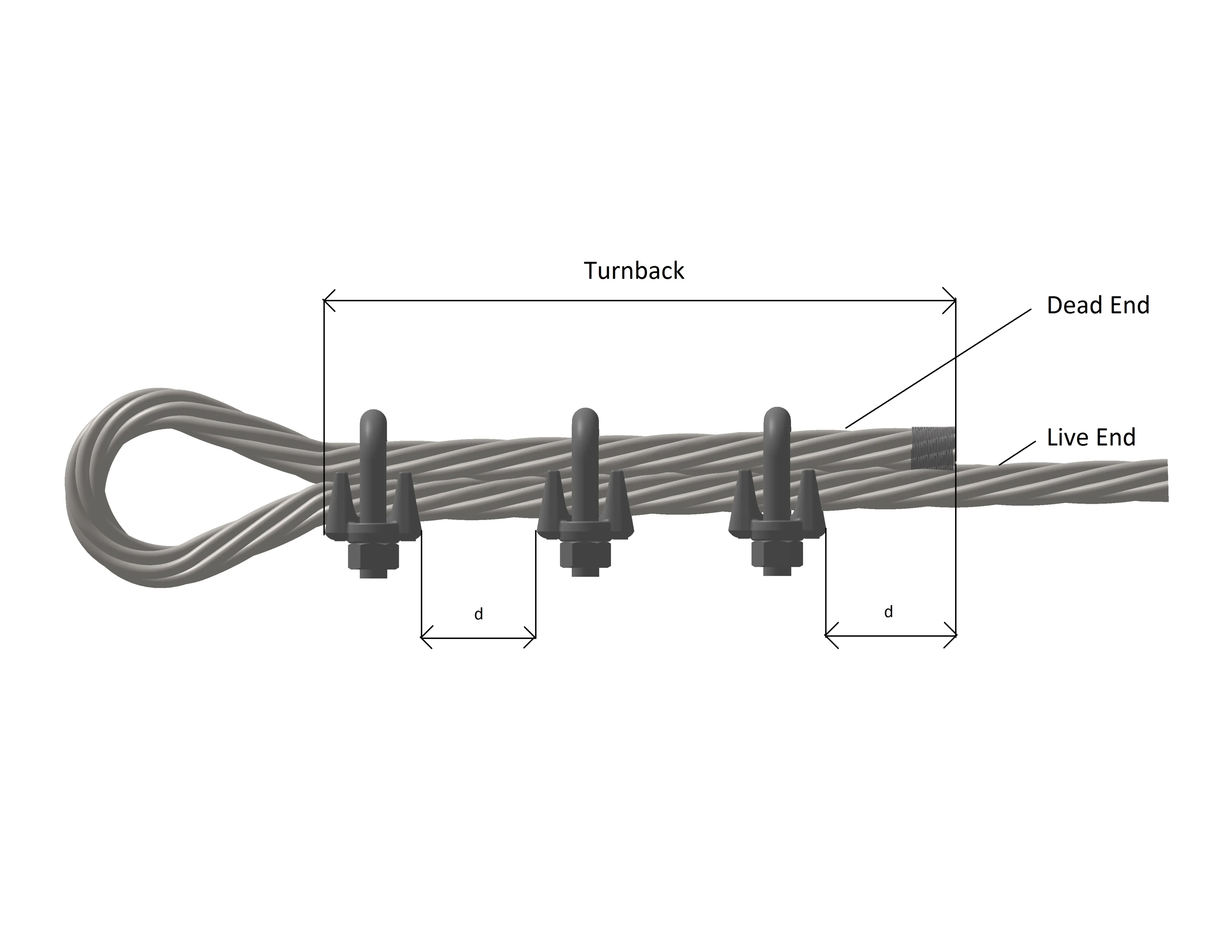
The clip secures the dead end of the wire rope against the live, load-bearing part of the rope to form an eye or termination.
One of the most important installation rules is:
U-bolt on the dead end, saddle on the live end.
This is commonly remembered in the rigging industry by the phrase:
“Never saddle a dead horse.”
Correct orientation helps avoid unnecessary pressure and deformation on the load-bearing part of the rope.
Drop Forged, Malleable or Stainless Steel?
Not all wire rope clips that look similar are designed for the same application.
Drop Forged Wire Rope Clips
Drop forged wire rope clips are made from forged steel and are commonly selected for industrial and more demanding applications.
Compared with malleable iron clips, forged clips generally provide better toughness and mechanical performance.
Typical applications include:
- Industrial rigging
- Construction
- Mining
- Marine equipment
- Heavy-duty cable assemblies
- General engineering applications
However, buyers should not assume that every forged wire rope clip is automatically suitable for lifting.
The actual product rating, applicable standard and intended application should always be checked before use in critical or load-bearing systems.
Malleable Wire Rope Clips
Malleable wire rope clips are generally more economical and are commonly used for lighter-duty or non-critical applications such as:
- Fencing
- Guard cables
- General cable securing
- Static cable assemblies
- Light industrial applications
They should not be treated as a direct replacement for a rated forged clip in a critical rigging system.
This is also important when comparing quotations.
If one supplier offers a malleable iron clip and another offers a drop forged steel clip, the price difference may reflect a completely different product specification rather than simply a higher supplier margin.
Stainless Steel Wire Rope Clips
Stainless steel clips are usually selected where corrosion resistance is a priority.
Common materials include:
- SS304
- SS316
SS304 is widely used for general outdoor applications, while SS316 is often preferred for marine, coastal and chloride-containing environments.
When purchasing stainless steel clips, it is worth confirming the material of the U-bolt, saddle and nuts, rather than checking only the general material description of the finished product.
How to Select the Right Wire Rope Clip
Choosing a wire rope clip should start with the application rather than the price.
1. Confirm the Wire Rope Diameter
The clip size must match the corresponding wire rope diameter.
Common requirements may include:
6 mm, 8 mm, 10 mm, 12 mm, 16 mm or equivalent inch sizes.
An oversized or undersized clip may not clamp the rope correctly.
2. Tell the Supplier the Application
A supplier should know whether the clip will be used for:
- Lifting or rigging
- Load securing
- Marine equipment
- Structural cable
- Mining
- Fencing
- Power transmission
- General industrial use
This helps determine whether a drop forged, malleable, galvanized or stainless steel clip is more appropriate.
3. Confirm Material and Surface Finish
For general industrial applications, galvanized carbon steel is common.
For outdoor or more corrosive environments, buyers may consider:
- Hot-dip galvanized steel
- Stainless steel 304
- Stainless steel 316
The correct option depends on the environment, required service life and project specification.
4. Confirm the Required Standard
Wire rope clips are available in different designs and standards depending on the destination market and project.
If your project specifies a particular standard, drawing, material grade, test requirement or certification, include it in the RFQ.
This helps avoid a common purchasing problem: products with the same nominal size may not actually be technically equivalent.
How to Install Wire Rope Clips Correctly
Correct installation is essential to the reliability of a wire rope termination. Always follow the instructions provided by the clip manufacturer.
1. Keep the Correct Direction
For conventional U-bolt wire rope clips:
U-bolt → dead end
Saddle → live end
Installing the clip in the opposite direction may reduce the reliability of the termination.
2. Follow the Recommended Quantity and Spacing
The required number of clips and their spacing depend on the wire rope diameter, clip design and applicable standard.
Do not assume that adding more clips or placing them closer together will create a stronger connection. Refer to the relevant installation table for the specific product.
3. Tighten to the Specified Torque
Where a tightening torque is specified, use a torque wrench and tighten the nuts evenly.
After the assembly has been initially loaded, check the clips again and retighten the nuts if required by the manufacturer's instructions.
For critical or load-bearing applications, always follow the applicable standard and manufacturer's installation guidance.
How Many Wire Rope Clips Do You Need?
This is one of the most common questions from buyers.
However, there is no universal answer such as:
“Always use three clips.”
The required number can depend on:
- Wire rope diameter
- Clip type
- Clip manufacturer
- Rope construction
- Applicable standard
- Intended application
For this reason, the correct number should be selected from the installation table supplied for the specific clip.
A proper installation guide may provide information such as:
Wire Rope Diameter → Number of Clips → Turnback Length → Spacing → Torque
If these parameters are important to your project, ask the supplier for the relevant technical data before placing the order.
Common Wire Rope Clip Installation Mistakes
Most problems come from a few repeated mistakes.
Installing the Clip Backwards
Putting the saddle on the dead end is one of the most common installation errors.
The saddle should remain on the live end of the wire rope.
Using Too Few Clips
Reducing the number of clips to save cost or space may reduce the reliability of the termination.
Follow the applicable installation table rather than estimating the quantity.
Incorrect Spacing
More clips packed tightly together do not necessarily create a better connection.
The correct spacing and rope turnback length should be maintained.
Mixing Clip Directions
Conventional U-bolt clips in the same termination should maintain the same correct orientation rather than alternating directions.
Incorrect Tightening
Insufficient tightening may allow movement or slippage.
At the same time, uncontrolled excessive tightening may unnecessarily deform the rope.
Use the specified torque where applicable.
Forgetting to Retighten
Initial loading can cause the wire rope to settle.
This is why checking the nuts after the first load is an important part of proper installation.
What Should Be Checked During Inspection?
Wire rope clip assemblies should be inspected together with the surrounding wire rope.
Typical inspection points include:
Component | Check For |
|---|---|
Nuts | Loosening, damage or missing nuts |
U-bolt | Wear, bending or deformation |
Saddle | Cracks, deformation or excessive wear |
Surface | Severe corrosion or coating damage |
Wire rope | Broken wires, crushing, abrasion or corrosion |
Termination | Movement or rope slippage |
Thimble | Wear or deformation |
Clip position | Movement from the original position |
If the wire rope shows excessive wear, corrosion, structural deformation or slippage at the termination, the problem should be evaluated rather than simply tightening the clips again.
Inspection frequency should depend on:
- Application
- Working environment
- Loading frequency
- Applicable regulations
- Manufacturer's instructions
A frequently used industrial rigging assembly clearly requires a different inspection approach from a static, non-critical cable connection.
What Should You Include in a Wire Rope Clip RFQ?
For a faster and more accurate quotation, provide as much of the following information as possible:
- Wire rope diameter
- Clip type
- Drop forged or malleable
- Carbon steel or stainless steel
- Surface finish
- Required standard
- Application
- Quantity
- Testing or certification requirements
If you do not yet have a complete specification, wire rope diameter + intended application is often enough to start the discussion.
At SENOTECH, we can help compare suitable wire rope clip types, materials, finishes and specifications based on your project requirements.
This is particularly useful when quotations from different suppliers look similar but the products are actually manufactured from different materials or designed for different applications.
Final Thoughts
Selecting a wire rope clip is not simply a matter of finding the correct diameter.
A reliable termination depends on choosing the appropriate product, installing it in the correct direction, using the required number of clips, applying the correct torque and inspecting the assembly regularly.
For buyers, one simple rule is especially useful:
Do not compare wire rope clips by unit price until you confirm that the specifications are actually the same.
If you are sourcing drop forged wire rope clips, galvanized wire rope clips, stainless steel wire rope clips or other wire rope accessories, send SENOTECH your demand for wire rope diameter, application, required standard and quantity.
We can help you identify the suitable specification and prepare a quotation for your project.